
Stap Wireless
Future Trends in Assistive Devices: AI, Voice Technology, and Smart Accessibility
Aug
What Are the Future Trends in Assistive Devices?
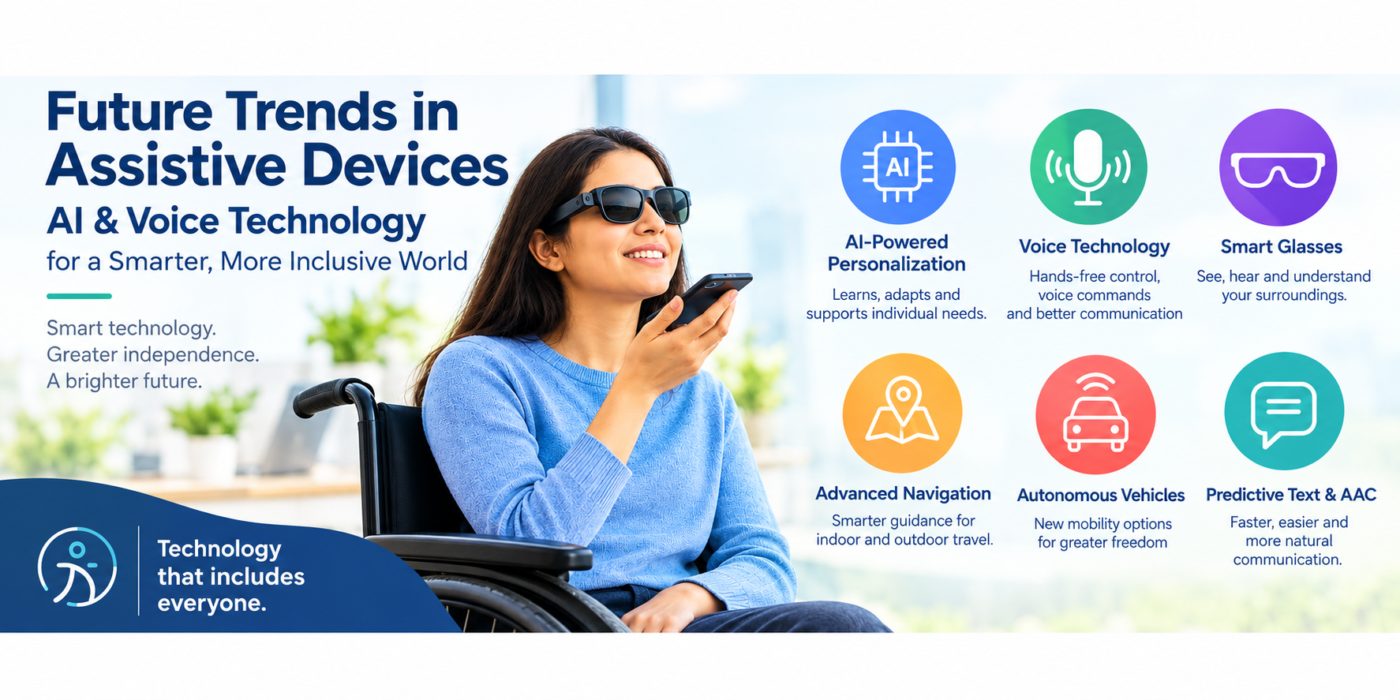
The Future Trends in Assistive Devices: AI, Voice Technology, and Smart Accessibility are changing how people with disabilities interact with technology, communicate, learn, work, and move independently. Assistive technology is no longer limited to traditional mobility aids or basic communication equipment. Advances in artificial intelligence, machine learning, computer vision, voice recognition, and connected devices are creating more personalized and responsive solutions.
The goal is not simply to make devices smarter. It is to make everyday technology easier, more natural, and more useful for the individual. Modern assistive devices can recognize surroundings, interpret speech, predict user needs, convert text into audio, provide navigation support, and help people communicate in ways that were previously difficult or impossible.
As these technologies become more affordable and widely available, accessibility is increasingly becoming part of mainstream technology rather than a separate category.
How Is Artificial Intelligence Redefining Accessibility?
How is AI making assistive devices more personalized?
Artificial intelligence allows assistive technology to learn from patterns and respond to individual preferences. Instead of providing the same experience to every user, AI-powered systems can adapt their behavior based on how a person communicates, moves, reads, or interacts with digital content.
For example, an AI-powered communication application can learn frequently used words and phrases and suggest them at the right time. Similarly, an accessibility assistant can identify frequently visited locations or commonly used commands and make them easier to access.
This shift from basic automation to personalization can reduce the amount of effort required to complete everyday tasks.
Why is human-centered design important?
Technology should support independence rather than create additional complexity. Human-centered design focuses on the actual experiences and challenges of users with disabilities.
Developers increasingly need to involve people with disabilities throughout product development and testing. Their feedback can reveal usability problems that may not be obvious during technical development. This approach can help create assistive devices that are practical, comfortable, understandable, and respectful of user preferences.
What Are the Latest Technology Trends for Visually Impaired Users?
How can smart glasses improve everyday independence?
Smart glasses are becoming an important area of accessibility innovation. Cameras and AI systems can analyze objects, printed text, signs, and surrounding environments and provide information through audio.
A user may be able to point a camera toward a document and hear the text read aloud. Depending on the technology, smart glasses may also describe a scene, identify objects, recognize familiar people, or provide contextual information.
These capabilities can be particularly useful when traditional visual information is difficult to access.
How is AI improving indoor and outdoor navigation?
Navigation technology is also becoming more sophisticated. AI, GPS, computer vision, sensors, and connected infrastructure can work together to provide more detailed guidance.
Future systems could offer information about obstacles, entrances, crossings, public transport locations, and indoor routes. Instead of simply saying where a person is located, an intelligent navigation assistant could provide context about what is around them and suggest practical next steps.
Could autonomous vehicles become assistive devices?
Autonomous driving technology could eventually provide new mobility opportunities for people who cannot drive independently. Cameras, LiDAR, radar, mapping systems, and AI-based image processing allow vehicles to interpret their surroundings and make driving decisions.
Although fully autonomous transportation still faces technical, regulatory, and safety challenges, continued development could eventually make independent travel more accessible.
How Are Voice and Communication Technologies Advancing?
What role does AI play in predictive text and AAC?
Augmentative and alternative communication (AAC) technology helps people who have difficulty using speech communicate with others. AI can make these systems faster by predicting words, phrases, and sentences based on context.
Instead of selecting individual words repeatedly, a user may receive intelligent suggestions that reflect their communication style. This can make conversations more efficient while reducing physical and cognitive effort.
What is personalized voice synthesis and voice banking?
Personalized voice technology is another major development. People with progressive conditions that may affect their ability to speak can potentially record their voice while they still have the ability to do so.
AI-based voice synthesis can then create a digital voice based on those recordings. The technology can help preserve a person’s familiar voice for future communication through an AAC device or other communication platform.
What Are the Latest Technologies Behind Speech-Generating Gadgets?
The Latest Technology Behind Speech-Generating Gadgets includes AI-powered predictive text, advanced text-to-speech, personalized voice synthesis, and on-device processing. These technologies help users turn words or messages into natural-sounding speech quickly.
Modern devices can learn vocabulary preferences, predict phrases, and support multilingual communication. Future advancements are expected to bring more natural voices, faster responses, offline functionality, and greater personalization for everyday communication.
How can real-time captioning improve communication?
Real-time speech recognition can convert spoken conversations into text almost instantly. This can support people who are deaf or hard of hearing during meetings, lectures, appointments, and everyday conversations.
AR glasses and mobile devices could eventually display captions directly within the user’s field of view, reducing the need to constantly look at a separate screen.
How Can AI Transform Education and Digital Learning?
Can AI create personalized learning experiences?
AI-powered educational platforms can adjust content according to a learner’s pace, preferences, and requirements. Text can be converted into speech, complicated information can be simplified, and lengthy material can be summarized.
For students with disabilities, these capabilities can make educational resources more flexible. Instead of relying on one standard format, learners can access information through audio, text, visual explanations, or interactive tools.
How can technology support neurodiverse students?
AI tools can assist with organization, planning, summarization, reminders, and task management. A large assignment, for example, can be divided into smaller steps with suggested deadlines.
These tools are not intended to replace teachers or students’ own decision-making. Their value lies in reducing unnecessary barriers and helping learners manage complex tasks more independently.
Can assistive technology support educators with disabilities?
Yes. Voice commands, accessible presentation tools, screen readers, automatic transcription, and alternative input methods can help educators create teaching materials and manage digital tasks.
Accessible charts, readable documents, keyboard navigation, and properly structured online resources can also make educational environments more inclusive for teachers and staff.
What Is the Market Outlook for Assistive Technology?
The assistive technology market is expanding as accessibility becomes a larger consideration in healthcare, education, employment, consumer electronics, and public infrastructure. Growth is being supported by developments in AI, connected devices, wearable technology, speech recognition, and mobile computing.
The market includes hardware, software, and hybrid solutions. Smart canes, communication devices, braille displays, screen readers, wearable sensors, accessible smartphones, navigation systems, and AI-powered applications all contribute to this broader ecosystem.
Rather than depending on one device, future users may have several connected tools working together. A smartphone, wearable device, communication system, and navigation assistant could share information to create a more seamless accessibility experience.
What Challenges Could Slow the Adoption of AI-Based Assistive Devices?
How should developers address privacy and algorithmic bias?
AI-powered accessibility tools may process highly personal information, including speech, location, images, behavioral patterns, or communication data. Strong privacy protections are therefore essential.
Developers should clearly explain what information is collected, how it is processed, where it is stored, and how users can control their data.
Algorithmic bias is another concern. AI systems should be trained and tested using diverse datasets so that their performance does not disadvantage particular groups of users.
Why are simplicity and training still important?
Advanced technology is only useful when people can understand and operate it. Complex interfaces, expensive hardware, limited technical support, and poor training can prevent users from benefiting from otherwise powerful devices.
Future assistive technology should therefore focus not only on advanced features but also on affordability, reliability, accessibility, simple interfaces, and effective user support.
What Does the Future of Smart Accessibility Look Like?
The next generation of assistive technology is likely to become more connected, personalized, and intelligent. AI may help devices understand context rather than simply respond to individual commands. Voice systems could become more natural, wearable technology could provide continuous assistance, and accessibility features could become standard across everyday digital products.
The most important development, however, will be the continued focus on independence and choice. Technology should give users greater control over how they communicate, learn, work, travel, and interact with the world.
From AI-powered smart glasses and predictive communication systems to personalized voice technology and intelligent navigation, assistive devices are moving toward a future where accessibility is built into the technology people use every day.
Conclusion
The future of assistive devices is being shaped by AI, voice technology, smart wearables, and connected accessibility solutions. These innovations can make communication, education, navigation, employment, and everyday activities more accessible and personalized.
As technology continues to develop, the focus should remain on independence, simplicity, affordability, privacy, and user choice. AI-powered smart glasses, predictive communication systems, personalized voice technology, and intelligent navigation are moving assistive technology toward a more connected and inclusive future.
Frequently Asked Questions
What is AI-based assistive technology?
AI-based assistive technology refers to computer systems that use artificial intelligence to perform tasks such as pattern recognition, speech processing, prediction, image analysis, and decision support. These capabilities can help increase independence for people with disabilities.
How do smart glasses benefit people with visual impairments?
Smart glasses can combine cameras, sensors, and AI to provide audio descriptions of surroundings, read printed text, identify objects, and offer contextual information. Their usefulness depends on the specific features and accessibility needs of the user.
What AI tools can support students with disabilities?
Useful tools can include text-to-speech applications, speech-to-text software, writing assistants, summarization tools, planning applications, and AI-powered learning platforms. The right technology depends on the student’s individual requirements.
What is Personal Voice technology?
Personal Voice technology allows a person to create a synthesized voice based on recorded speech. It can be particularly valuable for people who may gradually lose their ability to speak and want to preserve a familiar voice for future communication.
How is AI affecting employment for visually impaired users?
AI-powered screen readers, voice-controlled applications, OCR tools, transcription systems, and accessible workplace software can help visually impaired professionals access digital information and complete complex tasks more independently. Better accessibility can reduce barriers across recruitment, training, communication, and daily work.
